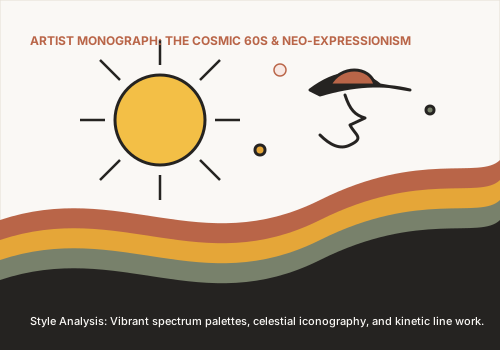
Few artists defined the visual vernacular of an entire generation as decisively as Peter Max (born Peter Max Finkelstein, October 19, 1937). During the late 1960s and early 1970s, his vibrant "Cosmic 60s" style—characterized by electric rainbow spectrums, floating celestial bodies, whimsical cosmic runners, and crisp bold outlines—became the visual soundtrack to the peace movement, Woodstock generation, and modern American graphic design.
Grea Foundation publishes this profile strictly as an independent educational art monograph. Grea Foundation is not affiliated with, endorsed by, or sponsored by Peter Max, Peter Max Studio, or licensing entities. All artwork references are cited for educational commentary and historical analysis under fair-use principles.
Early Influences: From Shanghai Pagodas to the Art Students League
Max was born in Berlin, Germany, but his family fled the Nazi regime in 1938, settling in Shanghai, China, where he spent the first decade of his childhood. Living across from a Buddhist temple, young Max was captivated by calligraphic brushwork, bright Buddhist temple scrolls, and Asian philosophies of color and harmony. After subsequent moves to Tibet, Israel, and Paris, his family arrived in Brooklyn, New York in 1953.
In New York, Max received rigorous classical training at the Art Students League under painter Frank J. Reilly, a master of realism who emphasized strict anatomical value control and lighting planes. This traditional foundation gave Max the disciplined draftsmanship needed to later simplify and stylize forms into explosive pop icons.
The Cosmic 60s Aesthetic: Spectrum Lines & Celestial Motifs
In the mid-1960s, Max pioneered a fresh commercial and fine art aesthetic that captured America's fascination with the Space Race, Eastern philosophy, and youth counterculture. Key visual hallmarks of his style include:
- Chromatic Spectrum Bands: Adjacent rainbow bands (red, orange, yellow, green, blue, violet) flowing in synchronized waves across landscapes and figures.
- Celestial Iconography: Beaming suns with faceted geometric rays, crescent moons, floating Saturn rings, and shooting stars.
- The Cosmic Walker: Stylized silhouette figures wearing fedoras, coats, or robes walking joyfully across celestial horizons.
- Graphic Inking & Lithography: Heavy, black contour outlines reminiscent of comic art, combined with saturated commercial printing inks.
Evolution into Neo-Expressionism
In the 1980s and 1990s, Max transitioned from clean graphic poster lithography to an expressive, heavily textured acrylic painting style. Working on monumental canvases with thick palette knife impasto, he created series honoring American landmarks (the Statue of Liberty), legendary musicians, and cultural icons, cementing his reputation alongside Andy Warhol and Keith Haring as a titan of commercial Pop Art.
Discover More Art & Technique Resources
Study how color palettes interact in our Art Techniques Directory, or compare twentieth-century pop stylization with classical Renaissance methods in our Mona Lisa Study.