Painted between 1503 and 1519 by Renaissance polymath Leonardo da Vinci, the Mona Lisa (known in Italian as La Gioconda and in French as La Joconde) hangs today in the Musée du Louvre in Paris as the single most famous painting in human history. Measuring just 77 by 53 centimeters (30 by 21 inches) on a modest poplar wood panel, its enduring power resides in Leonardo's revolutionary optical techniques, psychological depth, and compositional mastery.
Extensive archival scholarship, reinforced by the discovery in 2005 of an annotated manuscript by Florentine official Agostino Vespucci dated October 1503, confirms that the sitter was Lisa Gherardini, the wife of wealthy Florentine silk merchant Francesco del Giocondo. While commissioned as a private portrait, Leonardo never delivered the painting to Francesco, keeping it with him until his death at the Château du Clos Lucé in Amboise, France in 1519.
The Sfumato Technique: Painting Without Outlines
Leonardo famously observed that "light and shadow should blend without lines or borders, in the manner of smoke" (sfumato). While his contemporaries in Florence relied on crisp preparatory inking and sharp contour outlines, Leonardo revolutionized oil painting by applying dozens of translucent glazes—each only a few micrometers thick—blending tonal transitions imperceptibly.
Nowhere is sfumato more evident than around the sitter's mouth and the corners of her eyes. By deliberately blurring the corners of the lips, Leonardo created an optical ambiguity: when viewed directly, the fovea of the human eye detects fine details where the smile appears neutral; when the viewer glances slightly away toward the eyes or cheeks, the peripheral vision picks up the soft shadow glazes, making the mouth appear to lift into a warm smile. This physiological interaction is the true source of the "enigmatic smile."
Pyramidal Geometry and Atmospheric Horizon
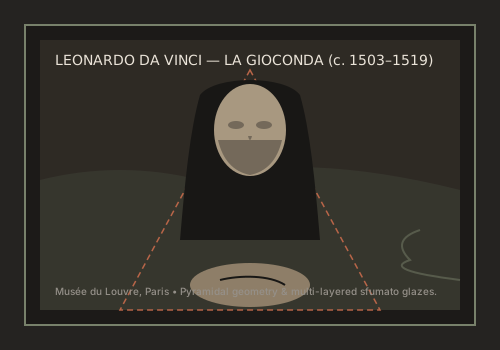
The composition of the Mona Lisa established the classical Renaissance portrait formula. Leonardo seated Lisa in an armchair with her hands crossed in the foreground, forming the broad, stable base of a three-dimensional pyramid that culminates at her head. This stable geometric triangle conveys profound serenity and psychological presence.
Behind Lisa lies an extraordinary imaginary landscape of jagged limestone peaks, winding rivers, and a distant Renaissance arched bridge. Notably, the horizon on the left is positioned noticeably lower than the horizon on the right. This subtle asymmetry causes the viewer's gaze to shift continuously across the panel, creating a dynamic visual rhythm between the serene sitter and the primeval landscape.
| Technical Aspect | Documented Specification | Scholarly Significance |
|---|---|---|
| Support | Single Poplar Wood Panel | Common in 16th-century Tuscan workshops; requires strict humidity control. |
| Medium | Oil Glazes on Gesso Ground | Allowed Leonardo to build 30+ translucent layers of linseed/walnut oil. |
| Dimensions | 77 cm × 53 cm (30.3 in × 20.9 in) | Intimate domestic portrait scale rather than monumental palace fresco. |
| Location | Musée du Louvre, Salle des États | Acquired by King Francis I of France in 1518; protected behind bulletproof glass. |
The 1911 Theft and Global Celebrity
While celebrated among art connoisseurs for centuries, the Mona Lisa became a global cultural sensation on August 21, 1911, when it was stolen from the Louvre by Vincenzo Peruggia, an Italian handyman who believed the painting belonged in Florence. The subsequent international manhunt, empty wall in the Louvre, and sensational recovery two years later catapulted the painting into mainstream world fame.
Related Art Historical Studies
Contrast Renaissance masterworks with twentieth-century Pop Art in our monograph on Peter Max and the Cosmic 60s, or study foundational drawing methods in our Art Techniques Hub.