Hands are universally acknowledged as the most challenging subject in figure drawing. With twenty-seven individual bones, dozens of articulating joints, and immense range of motion, hands easily devolve into stiff "rakes" or swollen "sausages" if approached without a clear structural method. By mastering the palm box, the knuckle arc, and proportional ratios, you can draw hands from any angle with confidence.
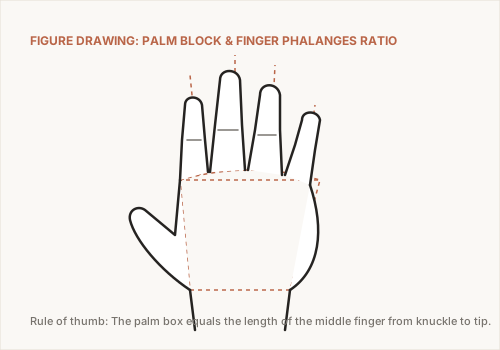
The length of the palm (from the wrist crease to the knuckles) is roughly equal to the length of the middle finger (from knuckle to tip). Furthermore, each finger segment (phalange) is approximately two-thirds the length of the segment preceding it.
Step-by-Step Hand Construction Breakdown
Construct the Palm Wedge Box
Do not start with fingers. Begin by sketching a sturdy, slightly curved wedge representing the palm. The palm is wider across the knuckles than at the wrist, creating a soft trapezoid.
Give the box 3D thickness: the palm is not a flat sheet of paper, but a cupped arch designed to grip objects.
Establish the Knuckle Arc and Finger Trajectories
Across the top of the palm box, draw a sweeping curved arc. The middle knuckle sits at the highest point of this arc, with the index, ring, and pinky knuckles sloping gently downward on either side.
Lightly draw four directional gesture lines extending from the knuckles to represent the centerline axis of each finger.
Segment Fingers into Articulated Cylinders
Each of the four fingers contains three phalanges (segments). Draw them as interconnected cylinders that taper toward the fingertips.
Mark the joint hinges with small ellipses. Remember that fingers are fleshy: they feature soft pads on the underside and bony landmarks across the top joints.
Anchor the Thumb Muscle Mass and Opposition
The thumb attaches to the side of the palm via a massive muscular teardrop called the thenar eminence. Unlike the four fingers, the thumb only has two visible phalanges outside the palm and operates on a rotated plane.
Position the thumb pointing naturally toward the fingers, matching the gesture of grasping or resting.
Mastering Hand Line Work and Values
Refine your contours with our Line Art Mastery Guide, or study the historic portrait hands of Renaissance masters in our Mona Lisa Scholarly Analysis.